


[I’ve read a lot on “re-enchantment” — or the rediscovery of the perennial enchantment inherent in authentic Christianity — so I thought I’d add a small reflection of my own.]
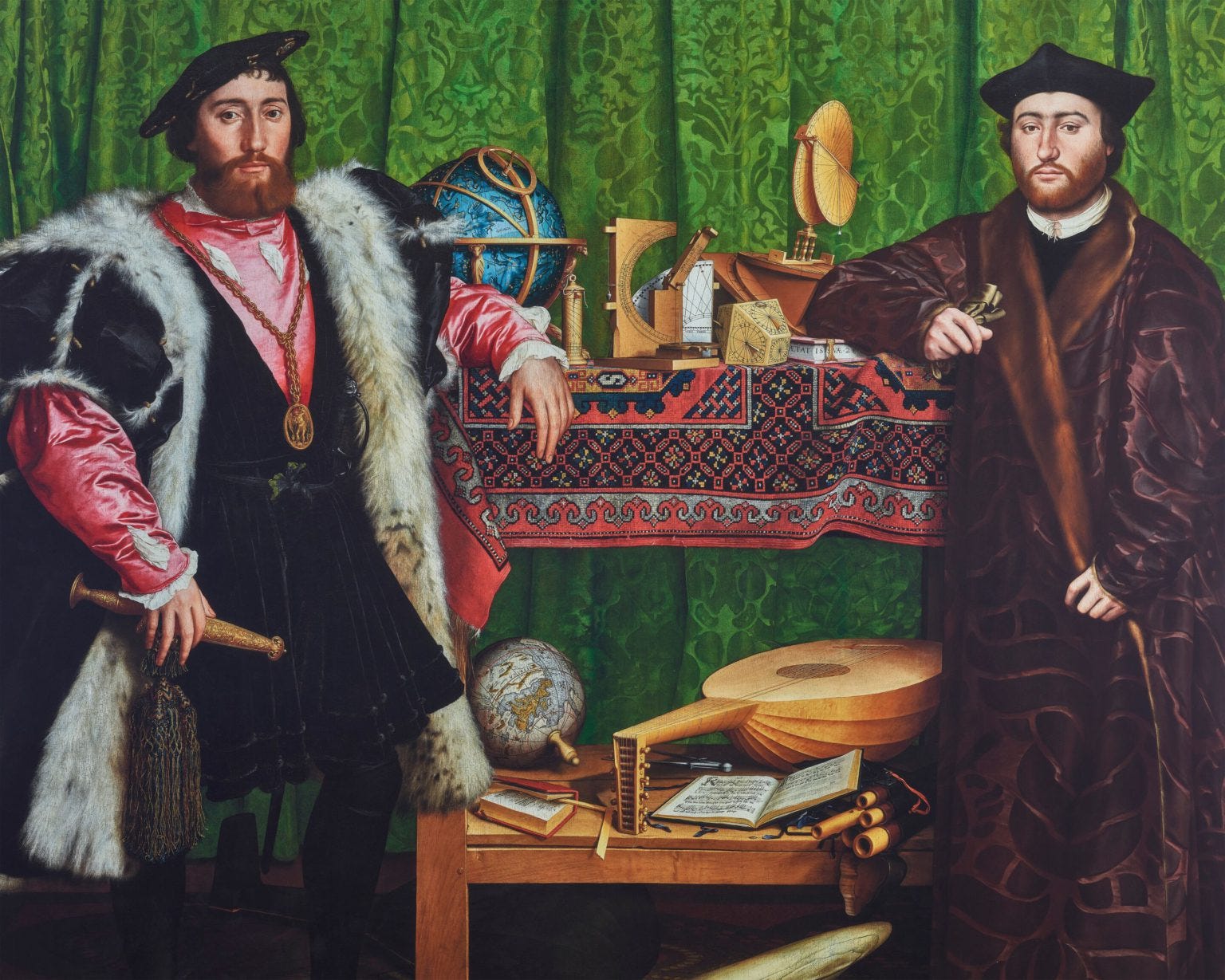
Hans Holbein’s The Ambassadors (1533) is more than a portrait of two French envoys. It is a temple in paint, guarded by twin pillars, a twofold arcana: Jean de Dinteville, clothed in velvet and fur, embodying worldly authority — the Magician (I) of will, action, and mastery; and Georges de Selve, robed in clerical austerity, signifying spiritual learning — the Hierophant (V) of mediation, tradition and authority. Between them stretches a table draped with a Persian carpet, upon which rests an encyclopedia of Renaissance knowledge. Yet this image is not simply about what men possess, but about how men stand in time.
On the upper shelf lie instruments of the heavens: Celestial globes, quadrants, sundials, an astrolabe — all designed to measure the great wheel of cosmic time. Below are human tools: A lute, a hymn book, mathematical texts, the fragile arts by which mortals harmonize their brief hours. Beneath, tilted at a strange angle, lies the distorted skull: Mortality’s anamorphosis, legible only when one shifts one’s perspective. 1 And in the corner, almost hidden behind a green curtain, hangs a Crucifix: The axis of eternity, glimpsed only by those who look beyond appearances. Cosmic time, human time, mortal time, eternal time — all converge in this painted chamber.
Here, time is not abstract but initiatory. The lute string breaks, the hymn fades, the sundial shadow moves, the skull reminds us: Death is certain. But the Crucifix whispers of a Kairos that transcends Chronos — a time of redemption breaking into the flow of hours. Holbein forces the viewer into an initiation: To see truly, one must change one’s vision, just as the anamorphic skull demands a new angle. Death is distorted only until one learns how to see. Only those who learn to see Death, see rightly. (“Modern man must see with the eye of the heart,” pled Schuon.) This vision cuts into our own age with prophetic sharpness. These two men were not yet thirty, yet they had accomplished feats of diplomacy, scholarship, and statecraft.2
By contrast, today’s long lives often stretch into prolonged adolescence. Many remain children into their thirties (or forties) — “mewling and puking in the nurse’s arm” (MacBeth) — not by a Grace of innocence3, but by torrents of meaningless diversion and sterile intrusion:
Gaming4, pornography, social media, unending consumption, physical unfitness, hollow relationships, tedious employments that neither demand nor reward greatness. What was once a short and perilous life that pressed men into maturity early has become a padded expanse of years where the urgent flame is smothered by endless trivialities — “distracted from distraction by distraction” (T.S. Eliot) — unfecund, decade-long — sometimes lifelong — possessions by the Noonday Devil.
Men once lived short, burning lives; we live long, smoldering ones. Our ancestors died younger but lived as though Eternity pressed on them; we live longer, but in flight from Time itself.
Holbein’s painting calls us back to another way of inhabiting Time. It urges us to live with urgency — for “The only thing between us and Heaven or Hell is only Life, which is the most fragile thing in the World,” as Pascal reminds us soberly.5 It presses us toward memory of our elders, our ancestors, our holy ancients, who though they lived short lives, lived deeply, sacramentally — adventurous, entrepreneurial, burning with a sense that each act mattered … because it does. And it beckons us toward re-enchantment: To see the cosmos not as a machine but as a temple — to see instruments and harmonies as veils of the eternal — and to recover the spiritual depths hidden in “holy distortions,” in anamorphoses, in living symbols — in the primordial seasons, cycles and celebrations of Time.6
Holbein has not merely given us likenesses of Men — he has staged an initiatory drama — a rich, pictorial Christian esoterism to be mined. The Ambassadors stand as the Boaz and Joakin7 at the portal of a hidden sanctuary — at the Sefirot of the Renaissance — but not a static historical epoch — the true Renaissance of religious revivification and resurrective rebirth in Christ — reblooming, regreening, kairotically into our “now.” What is the green curtain behind the men but the endless expanse of God’s viriditas inviting us — daring us even — to simply walk into Himself — into the timelessness of perpetual blossoming?
Before us are laid the tools of art, science, and politics — the whole span of worldly endeavor, that — when done in Christ and for Christ — extends salvifically into the life of the world-to-come. At our feet, the skull confronts us with the inevitability of Death — but also the deific Golgotha Mystery. In the curtain’s shadow, the Cross — the true Axis Mundi — shows us the key to Eternity. The Ambassadors is no simple portrait but a mirror of Time itself. To step into the painting is to be reminded: Youth is fleeting — the Flame needs tending — knowledge is incomplete, but Gnosis is still worth seeking — Death is certain but can be a gift — and Eternity waits, veiled, until we put on the Mind of Christ — internalize His Sacred Heart — and learn how to see.
Praised be Jesus Christ.
On anamorphosis as an initiatory act of vision, see Jurgis Baltrušaitis, Anamorphic Art (Cam.: MIT Pr., 1977). The distorted skull becomes a ritual demand: Without altered perspective, Truth remains hidden. This parallels the Zohar’s teaching that the Torah itself appears distorted until read with sod (deep mystical insight), which shifts the yearning soul’s “angle of vision.”
Jean de Dinteville (age 29) and Georges de Selve (age 24) embody the Renaissance paradox of rising youthful achievement under mortality’s heavy shadow. Their careers mirror the Cabalistic sense that the lower sefirot (Netzach, Hod, Yesod) mature early under the weight of cosmic destiny, even as Keter (Crown) remains veiled.
St. Francis of Assisi, “God’s jongleur,” St. Thérèse of Lisieux, the “Little Flower,” St. Joseph of Cupertino, the “child of Rome,” St. Bernadette Soubirous, the “poor little thing,” St. Philip Neri, the “flying saint,” and St. Gemma Galgani, the “docile one,” among many other saints and sages, embody this “Grace of innocence” — not naiveté, but a conscious re-entering of childlikeness — a recovery of Edenic simplicity through Christ. This is the restoration of the puer aeternus (“eternal child”), the primordial divine image unspoiled by cynicism or worldliness.
I love my son and would die a thousand deaths for him, but he loves to game. I fear it is overcompensation for my tendency to read and write and to collect (hoard really) books and artwork, and much of the fault lies with me. He is particular to Minecraft and Roblox and likes to build things, so I tell (or kid) myself this particular “Mathesis is good for the mind and blesses the soul” (Louis Claude de Saint-Martin.) I pray for him like St. Monica!
Blaise Pascal, Pensées, fragment 213 (Brunschvicg numbering): “Entre le ciel et l’enfer il n’y a que cette vie, qui est la chose la plus fragile du monde.” The frailty of the human person becomes here the hinge between Chronos and Kairos, mortality and eternality — the “Isaacite knife’s edge” that sweetens the sacrificial life but the “sword of Damocles” that endangers the sinful one.
Compare the great Hermetic maxim as above, so below (Emerald Tablet, line 2). Holbein’s upper shelf (celestial knowledge) and lower shelf (human arts) mirror the Sephirothic tree’s supernal and lower worlds. The skull may be read as Daath — the “non-Sefirah” of abyssal knowledge, endless-fathoms-deep — distorted, liminal, dangerous even, yet also the passageway between worlds.
Boaz and Joakin, the bronze pillars of Solomon’s Temple (1 Kings 7:21), later became symbols in Cabala, Rosicrucianism and Masonry of polarity — mercy and severity, the right and left pillars of the Tree of Life. In Holbein’s canvas, the two ambassadors occupy the roles of political and ecclesiastical “pillars,” flanking a temple of knowledge whose veil — the green curtain — conceals the hidden Cross, just as the Temple veil concealed the Holy of Holies. The God-Man’s conception into Salvation History rent the curtain of chronotic Time, just as His salvific Death rent the curtain of the Temple into paradisaical Eternity.