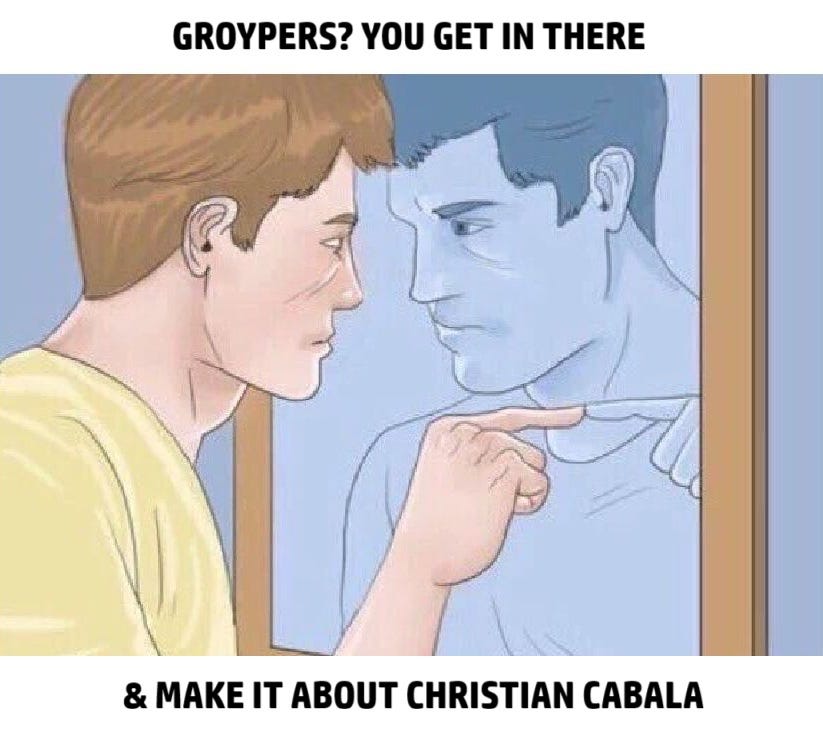
[This essay several requests — by individuals who identified themselves as Groypers — to examine various political movements through the same lens through which I examined the assassination of Charlie Kirk.]
“The serpent of mockery coils around the tree of life when the sons of men laugh without purpose; and the frog that croaks without being taught becomes the symbol of lost joy. But when the frog bows before the virgin moon-waters and the sun of justice, it becomes the stone of resurrection and bears the jewel in its head which scatters the poison of despair.” — Jakob Lorber
This essay “walks in a neighborhood of dangerous ideas” — it walks on the razor’s edge* between the Charybdis and Scylla of ruinously acerbic sociopolitical admonition and the very real “Groyper curse,” so I posit four caveats moving forward:
“What’s more dangerous — ideas — or this neighborhood?”
“If we live through this night — I just might tell you.” — Midnight in America
Introductio
“ … You and I are bound together on a journey that will twist the very fabric of nature … But beneath your mask of logic, I sense a fragility. That worries me. Steel your mind … I need you … ”— Lord Blackwell, Sherlock Holmes
If Paul Kingsnorth looks at Western civilization and solemnly says, “Let— it — die,” the Groyper movement snarls back with the primal insolence of disenfranchised youth: “No — you eat shit and die.” That sentence alone tells us everything we need to know about the archetype at play. This is not a well-mannered conservatism — part of a “grand old party.” It is the existence-mocking Trickster — the Jester-Prophet — the Frog-Chorus of Refusal croaking in Chaos and Old Night. Outsiders — columnists, academics, online clerics — dismiss Groypers as a swarm of misogynistic, meme-addled “angry young men.” But this reduction mistakes a fiery archetypal youth crisis for a simple pathology. In reality, they span age, temperament, and relationship status. They are ferociously countercultural; brilliantly irreverent; both purposefully and accidentally hyper-offensive — often in precisely the way prophets are. (If you doubt their intellectual seriousness, read this short book a Groyper — and fellow father — sent me recently: For a Thomist Fascism — linked for transparency, not necessarily for recommendation [1].) Their discourse runs the gamut. I have discussed finer points of Esoteric Christianity with a Groyper-father — and I have also been told: “Pls , for the love of Christ, kill yourself and your family you stupid geriatric f—.”
***
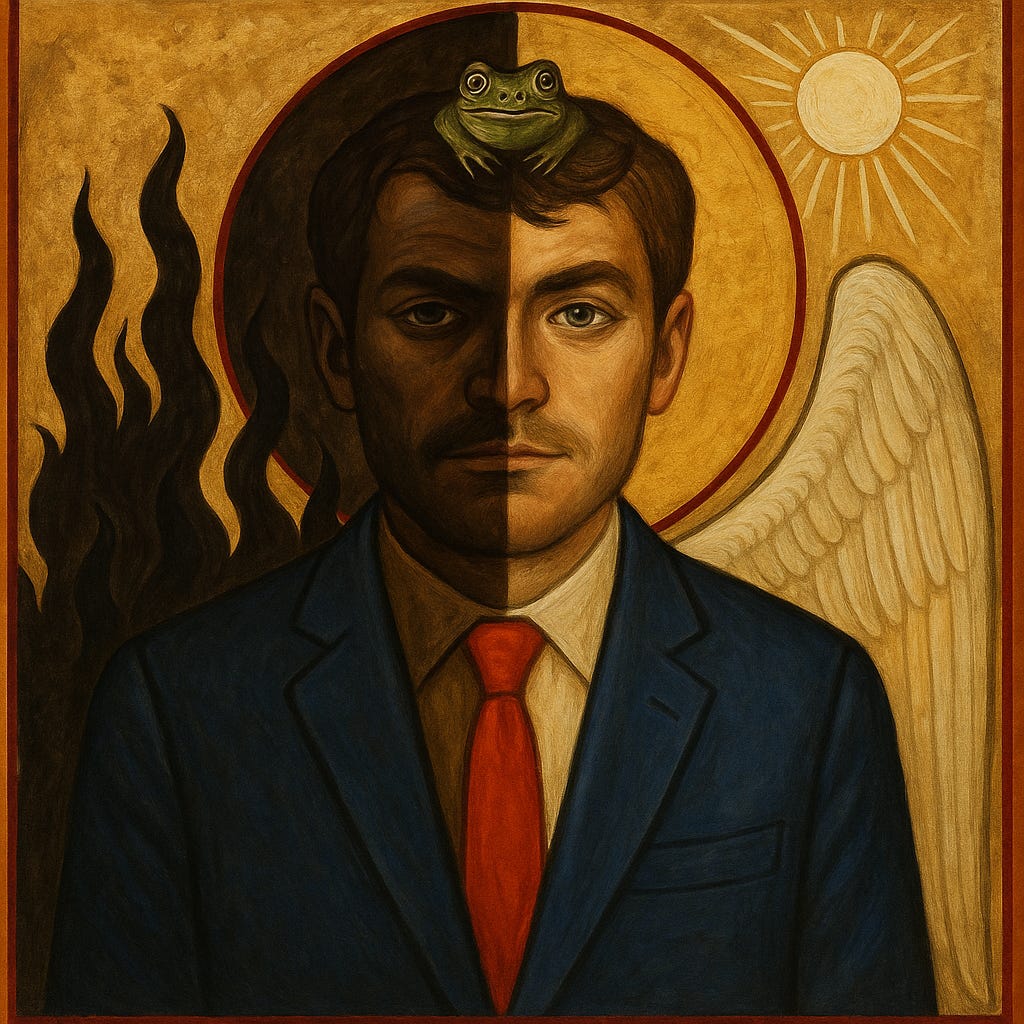
Every meme movement requires a mascot. Groypers have a Trickster King. Like it or not, Nick Fuentes has become the symbolic epicenter: The uber-polarizing, ebulliently corrosive, all-taunting, media-inflating, cascade-creating Hermes figure darting —(like poison-dart frog venom)— about the body politic. The question is not whether he is right or wrong politically. The question — for our purposes — is what his archetypal image renders to a generation of young men who find themselves so often spiritually fatherless.
Iuventus veritatem quaerit —“Youth seeks Truth.” Saints and shadows are equally truthful. Sometimes it finds a saint. Sometimes a shadow. As most often with Youth — by its nature, wildly mercurial — there is a Trickster — a Schattensheiliger — standing at the crossroads betwixt the barbs of dizzyingly complexifying irony and the balms of simple, honest sincerity — atomizing sterility and overfilling fruitfulness — the “carrion clown” and the “most gladdening king.” Crossroads are where criminals are hanged and vampires staked — or honest commerce thrivingly conducted (the noncriminal — the charitable) and endearing goodwill soul-bindingly trafficked (the non-vampiric — the Eucharistic.) There are many crossroads in the Tree of Life, coursing with the Aurum Potabile. But more so in the Tree of Death — inky entanglements of rotten roots.
“At the mirror of the Crossroads grows the Tree of Life — where the Trickster teaches reflection as Revelation.”
What happens when a meme attempts to incarnate itself?
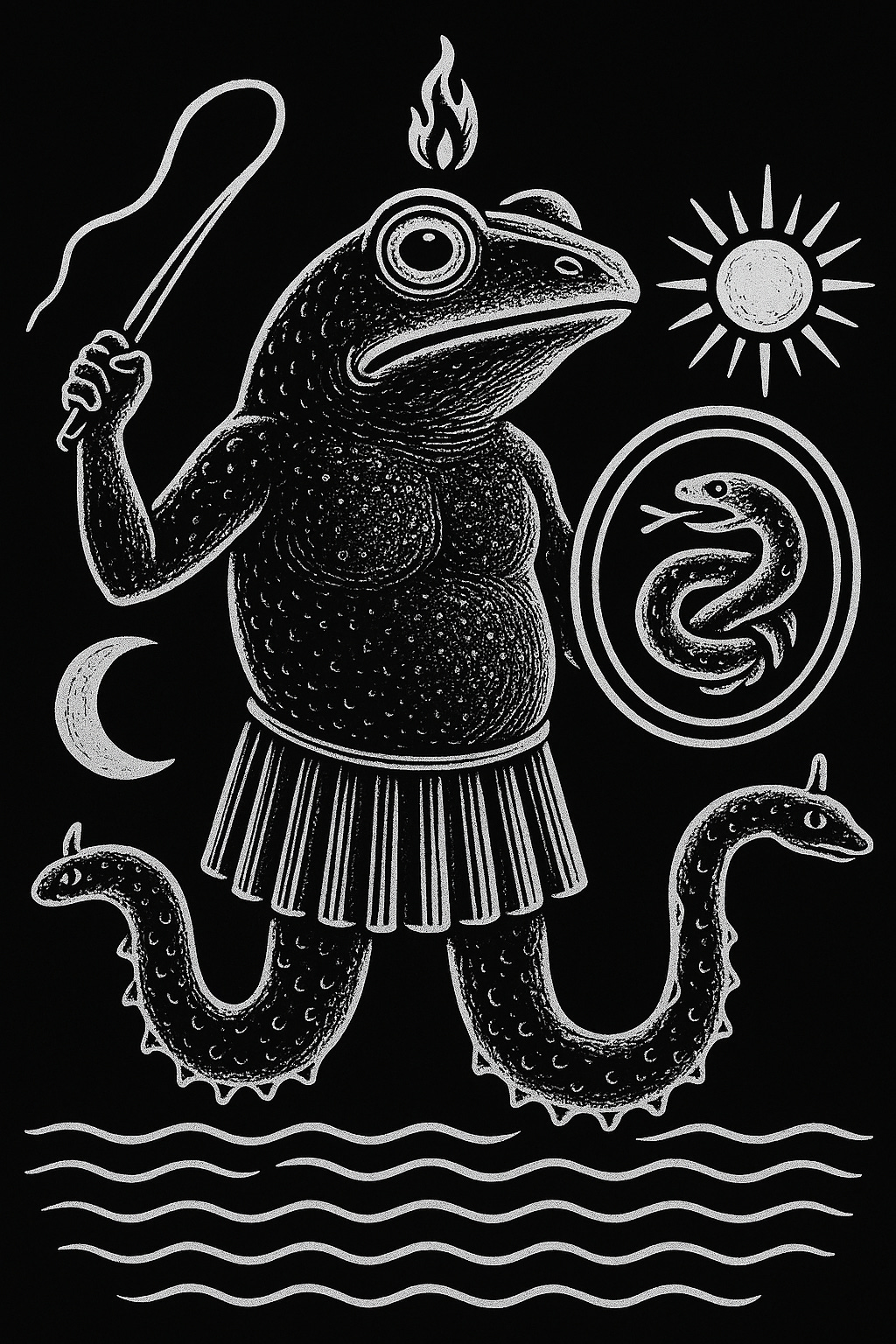
What happens when the toad tries on a crown? This is the spiritual riddle before us. And to solve it, we must begin with the creature itself: Mud-born, mucus-slick — both repulsive and beloved — a small green contradiction that has hopped its way into a theology of youth.
Let us turn to the Semiotics of the Toad.
1. Toad as Totem
“Sweet are the uses of adversity which, like the toad, ugly and venomous, wears yet a precious jewel in his head.” — William Shakespeare
“Frogs are smart — they eat what bugs them.” — William Greenough Thayer Shedd
The toad is fickle. We find in Holy Writ: “The Nile shall swarm with frog … They shall come up into your house and into your bedroom … ” (Ex. 8:3). “Three unclean spirits like frogs … are demonic spirits … ” (Rev. 16:13–14). Conversely — actually, complimentarily — in Hebraic midrash, the frog is the proto-martyr — the first creature to willingly sacrifice itself for God’s plan — jumping into an oven rather than disobey the Most High.
The toad emerges from the primordial waters — the Aquae Primordiales — the same womb-waters over which the Spirit of God hovered in the Beginning (Gen. 1:2.) Amphibian means twice-born — first from slime, then from the air — and hints at an “evolutionary baptismal anthropology” — the Anima Humana moving from the mud of “knowledge” to the pneuma of “knowing.”
It is no accident that in many ancient cultures, frog-goddesses are midwives of creation: Egypt’s Heket breathes souls into infants; the Mesopotamian Ninhursag is the mother of divine kings; the Slavic Ovinnik is the guardian of the hearth that makes families. In ancient Egypt and Abyssinia, frogs were believed to autogenerate from the fruitfulness of the mud of the Nile — and frog-laden daggers were balanced atop the bellies of pregnant women to protect the fruit of their wombs from disease and bewitchment. The toad — revolting yet fertile — becomes an alchemical symbol of the Uterine Abyss — the Abyssus Matricis — where deep calleth on deep — mud becomes life — and where boys become men by courageously passing through the Feminine, not unlike the Veil of Paroketh.
But the feminine has two faces. On one side stands what I call the “Lilith–Porneia Nexus”: Desire turned predatory and beauty weaponized against being. This is “sterile allure” — the devouring swamp that promises milk and honey but gives only pollutive mud and sludge. Online young men see this version of femininity everywhere: Self-denigrating OnlyFans priestesses — algorithmic Aphrodites plasticized beyond recognition of their humanity — bile-inducing corporate sexualities selling rebellion as product. A few clicks further can take you into dark and terrible territory. As a forensic psychologist, I found the Lilith–Porneia Nexus was the first “unraveling-point” leading to some horrific sexual crimes and the catalyst of some debased predation — or simply collapsed families and ruined men.
“Mind became enamored of its own shadow — thus was born Desire.” — The Divine Pymander
One might understand the instinct to flee. But to reject Woman altogether is to reject one’s own birth — and one’s own birthright. Which brings us to what I call the “Maria–Sophia Nexus”: The Virgin who makes God visible and the Wisdom who makes Love rational. Where Lilith refuses the child, Maria receives the Child into history. Where Porneia dissolves communion, Sophia structures it into a kingdom. [2] It calls to mind a line from one of my own poems:
A King without a Queen is without a Kingdom.
These two archetypes battle not only for the soul of woman but for the destiny of man. If the Groypers reject all femininity, they become something like pond-life without the possibility of metamorphosis — a fraternity of lost tadpoles with no fertile mother-waters to disembark from, and the sun of death will set forever on their drowned croaking.
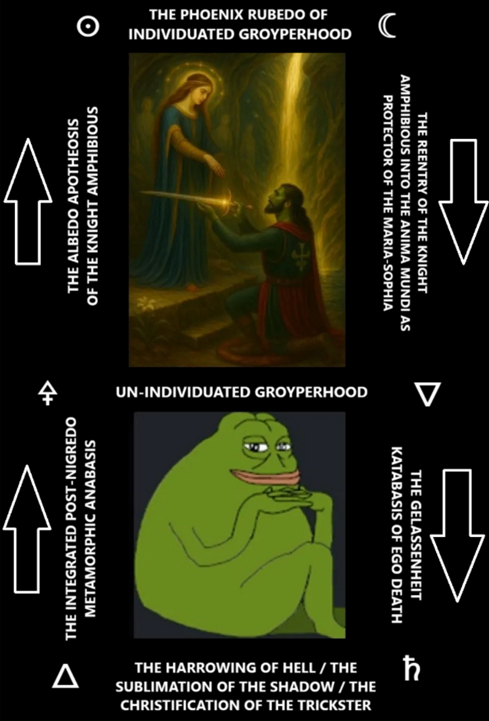
But if they reject only the corrupted feminine and turn — protectively — toward Maria-Sophia — the toad becomes a Knight Amphibian — the Sumpfritter: Not a frog self-sentenced to the Serbonian bog of unbecoming — but a prince guarding the Holy Fountain. Chivalry is simply this: The active protection of the good in woman. A culture becomes sterile when its men mock the womb instead of defending it. Thus, the Groyper-soul — like previous iterations of conflicted man —(reaching back to Antiquity — to the Old Covenant epoch — to post-Edenic expulsion)— stands poised between the anamnesis of chivalric vocation or the amnesia of masculine telos.
The frog-swamp is the chaotic cauldron of both life and death from which — psychically and psycho-evolutionarily — men are called to emerge, heroically and self-fulfillingly — slough off the sludge and slime of “placental becoming” — and build a garden of life in the midst of death, irrigated with those selfsame waters. The toad is waiting for a sword beyond himself.
T.O.A.D. Four Latent Elements (Quattuor Elementa Latentia / Elementa in Potential) → A.Q.U.A. Four Living Elements (Quattuor Elementa Viventia / Quattuor Elementa Viva / Elementa Animata / Elementa Vivificata) —T.O.A.D. = [T]errae [O]rigo, [A]mphibia [D]uplex — “Origin in earth; the double-lifed amphibian.” —A.Q.U.A. = [A]bysso [Q]uiescit, [U]bi [A]erat — “It rests in the abyss, until it breathes the air.”
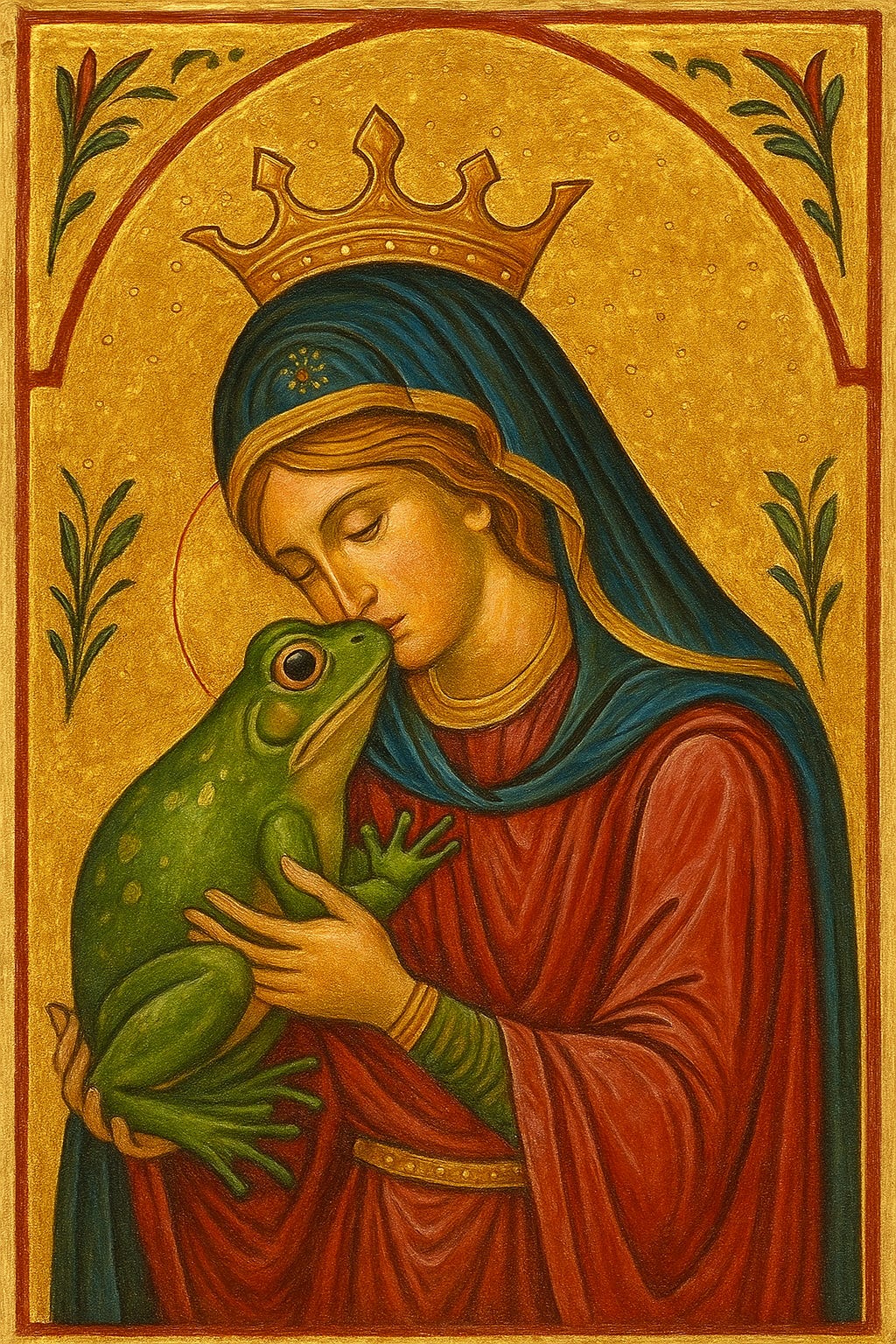
Domina Aquarum ranam in principem transformare potest. (“The Lady of the Waters can transform a Frog into a Prince” — the ultimate alchemy.)
2. The Frog as Folk Marian Icon
“ … The chthonic goddesses … contain tremendous energies … the hero must discover the ‘right’ attitude toward her destructive powers … by respecting her independence, he frees her — and she, in turn, will free him … ” — Francoise O’Kane, Sacred Chaos: Reflections on God’s Shadow & the Dark Self
“The frog whispered: You are the reason I believe in good things.” — An old fairytale
Every civilization tells two kinds of stories: Official theology (Kirchenlehre) — written by the Doctors — and Folk theology (Volksglaube) — whispered by the Midwives. (Caelum est filius medicorum et obstetricum — “Heaven is the Child of Doctors and Midwives.”) The frog belongs to the latter.
In medieval Europe, small frog or toad amulets — often with vulvar carvings — were placed near the shrines of female saints — especially Our Lady — as petitions for fertility, safe pregnancy, and the quickening of life in the womb. A Basicath [3] or Protestant ethos would find this hokey or heretical, but it is deeply instinctual, counter-heretical and Christo-Sophianic. A humble creature thought repulsive becomes a carrier of hope. Even high art secretly agreed: Look closely in certain Renaissance Madonna paintings and you will find a toad nestled by the Virgin’s foot — the maternal mud consecrated by the Queen of Heaven.
The symbolism is outrageous and perfect: Maria is the New Eve, Mother of the Living. The Toad is a creature of mud and mire, sign of the first creation. Christ in her arms is the Second Creation rising from her womb. The toad is the proto-baptismal beast transformed in her presence.
In other words, the frog meme is a joke, but Marian folk theology never laughs — for it deals with the sacredness of purity and vulnerability — the dignification of rapeable and exploitable womanhood — the protection of molestable and killable innocence — the reality of agony and suffering no sarcasm can escape — the hope of transformation in the deepmost suffering of Hell. The frog meme fears sincerity — Maria is what happens when sincerity becomes a person. The meme laughs to avoid its longing — Maria shelters the longing that outgrows the laugh.Irony hides what Mary reveals. The frog behind the meme says:
“All the things you pretend not to care about are the things that matter most.”
Thus, when a digital youth movement unconsciously adopts the frog as its mascot — it is committing a kind of “accidental Catholicism.” It is reenacting the oldest intuition of the Christian people: Life comes from mud only when the Mother watches over it. The meme knows. (This deep nexus recapitulates Fuentes’ own professed Catholicism and archetype as socioreligious Trickster.)
Moreover, in medieval lapidaries, it was said that a precious stone — the crapaudine or “toadstone” — could be found in the head of a special toad, glowing faintly and capable of detecting or neutralizing poison. Alchemically, it was the nigredo gem that promised resurrection from corruption. The toad, then, was not only the symbol of mud transformed by the Virgin’s presence but also the bearer of a hidden stone of transubstantiation — a Eucharistic prefigurement. As the Host is the living Stone within the Church’s body, so the toad bears within its skull the luminous counter-poison to the world’s venom.
In the Christian imagination, this “stone” becomes the analog of the Eucharist, the Lapis Viridis: The humble creature harboring the secret of divine flesh. The transmogrified Groyper — if he alchemizes for the good —(like we all must)— likewise carries a latent eucharistic capacity — the possibility that irony may become thanksgiving (Eucharistia) — that mockery may become miracle, as Truth Himself was mocked. What the Church calls “Real Presence,” the folk imagination calls “hidden fire in mud.” The meme itself yearns toward communion — it only needs sanctification.
“The Frog of Zebulun [i.e., the Cabalist], having ascended [literally “hopped up”] the Tree of Life, receives the סְפִירַת הַיָּהָלוֹם [Sefirat ha-Yahalom — i.e., “The Emanation of Diamond”] upon his brow that shines against all poison.” — Iona of Ferrara
There is additional evidence from the Old World of black coffins full of frogs and death-excreta being buried at certain Northern European gravesites, church narthexes and other crossroads of spiritual traffic serving as warnings, bewitchments or defixiones. There is an implication — in the deep sāṃdhyābhāṣā — that accessing the “frog imago” without respecting the Maria-Sophia nexus awakens the Dark Mother — the Kali of our own psychospiritual and civilizational Yugas — and invites apocalyptic destruction, personal and collective. There is, too, almost a hint of a latent vengeful Lovecraftian cosmicisim crawling beneath the blasphemed “frog-totem.” [4]
“Speak, Frog, and enter.”
One can investigate the fascinating 4chan biogenesis and accompanying lore of the word “Groyper” — but it has no real “etymology proper.” It is glossolalia — “logos-spark.” In the homonymical “green language” of Fulcanelli —(a double-pun already, as we are dealing with the “green life” of a frog)— the word “groans” (as in the pain of childbirth like creation right up to the present time {Romans 8:22}) — “grasps” for straws of meaning — “roils” like the primal alkahest — a Socratic fly in the “ointment” of the New Athens that seeks something “pure” and undefiled in the Desert Wasteland. It bursts forth like a tongue of Pentecost flame — a nonsense utterance that nonetheless gathers a crowd and creates a culture before it creates a creed.
“The tongue is the sword that cuts both Eden and Gehenna.” — The Zohar
But what is culture without respectful ritual? Marriage? Loving congress? Conception? Christened birth? A meme can propagate itself — endlessly — without producing fruit. And here lies the crisis, somewhere between Peter Pan and the postmodern Prometheus: A frog can be created without a Father. But without Fatherhood, there can be no Sonship — no Christ. Without the Christic Bridegroom, the Soul —(by its nature, receptively feminine)— cannot be a Bride. Without the Motherhood of Maria, masculinity becomes mockery. Without the Sisterhood of Sophia, knowledge becomes cynicism. Without a Woman to crown a King with gold, the crown dis-alchemizes into a jester’s cap; the Skull of the deific Golgotha Mystery is craniosected into an un-Christified constriction — the Mask of the King in Yellow — the shattered toadstone — braindeath. Youth has the fire — but needs an altar.
“The Toad bows to the Queen of the Lower Garden, and she turns its poison into dew.” — Theurgical lamellae fragment
The semiotics of the toad reveals a paradox: Meme fertility without metaphysical fecundity — generative humor that refuses generation — a baptismal symbol without immersive sacramentality. The “frog imago” — whose croaks are Voces Mysticae — remembers what the Jugendkultur have forgotten: The Divine Feminine is not the enemy but the alchemical VITRIOL — the Vital Wellspring — the very Lifeforce — of Masculine Becoming. When the meme bows to the Mother, it becomes mission. When the toad guards the womb, it becomes a knight. The amphibian’s evolution must be one into sacrality and service, or it will become atrophied — vestigial and anti-Vestal — and die off. I don’t want that.
“The salt of the world is laughter that heals corruption.” — Paracelsus
“My Lady clad herself in green, like meadows where the wind-waves pass … ” — G.K. Chesterton
R.A.N.A. → V.I.R.G.O. R.A.N.A. = [R]udis [A]byssus, [N]idus [A]quarum — “Rough abyss, a nest of waters.” V.I.R.G.O. = [V]irgo [I]mmaculata, [R]osa, [G]ratiae [O]rtus — “Immaculate Virgin, the Rose, the Spring of Graces.” “Lapis viridis in capite bufonis, hostia in gremio Mariae.” — “The green stone in the toad’s head, the Host in Mary’s lap.” RANA (4) + VIRGO (5) = 9 (Gestation →Donum Vitae.)
“… I am the one who is disgraced and the great one. Be on your guard! … Do not hate my obedience and do not love my self-control … For I am knowledge and truth. I am the one who is beyond opposites, and yet I am found in all of them … ” — Thunder Perfect Mind
3. The Trickster King at the Crossroads — Holy Fool or Shadow Tyrant?
“When I cry, the hills laugh; when I humble myself, the flowers rejoice; when I bow, all things are elated.” — Khalil Gibran, Rain
“You are the way of death; you are the gateway of ruin.” — Psychomachia
Having traced the feminine waters that baptize the frog, we now follow the masculine spark that seeks to crown it …
Every emerging generation produces a Trickster — a boundary-breaker who laughs at the guardians of dead empires. Hermes steals Apollo’s cattle for profane butchers. Loki mockingly drags severed heads into Odin’s hall. St. Francis of Assisi strips naked and flagellated in the filth-guttered street to reveal his Holy Poverty in the face of the Reges Mali.
“The misuse of a Toad calls to Heaven for human blood.” — William Blake (maybe)
A Trickster is necessary. He reveals hypocrisy by refusing to sit still for lies. And yet — the Trickster is the most dangerous archetype, because he stands closest to Typhon, the Destroyer. Nick Fuentes — not as politician, but as symbol — is the amphibian Hermes of Groyper youth: One foot in the swamp — one foot on the steps of the Temple — cackling at both. His power is pure ambivalence (and there is power in ambivalence itself): He can speak a word that becomes a sword — or a word that becomes a curse upon the womb — the Schoßfurcht. He can elevate irony into joy — or sharpen irony into despiteous, soul-killing spite. He can enliven with heartening speech — or speak disheartening words of death.
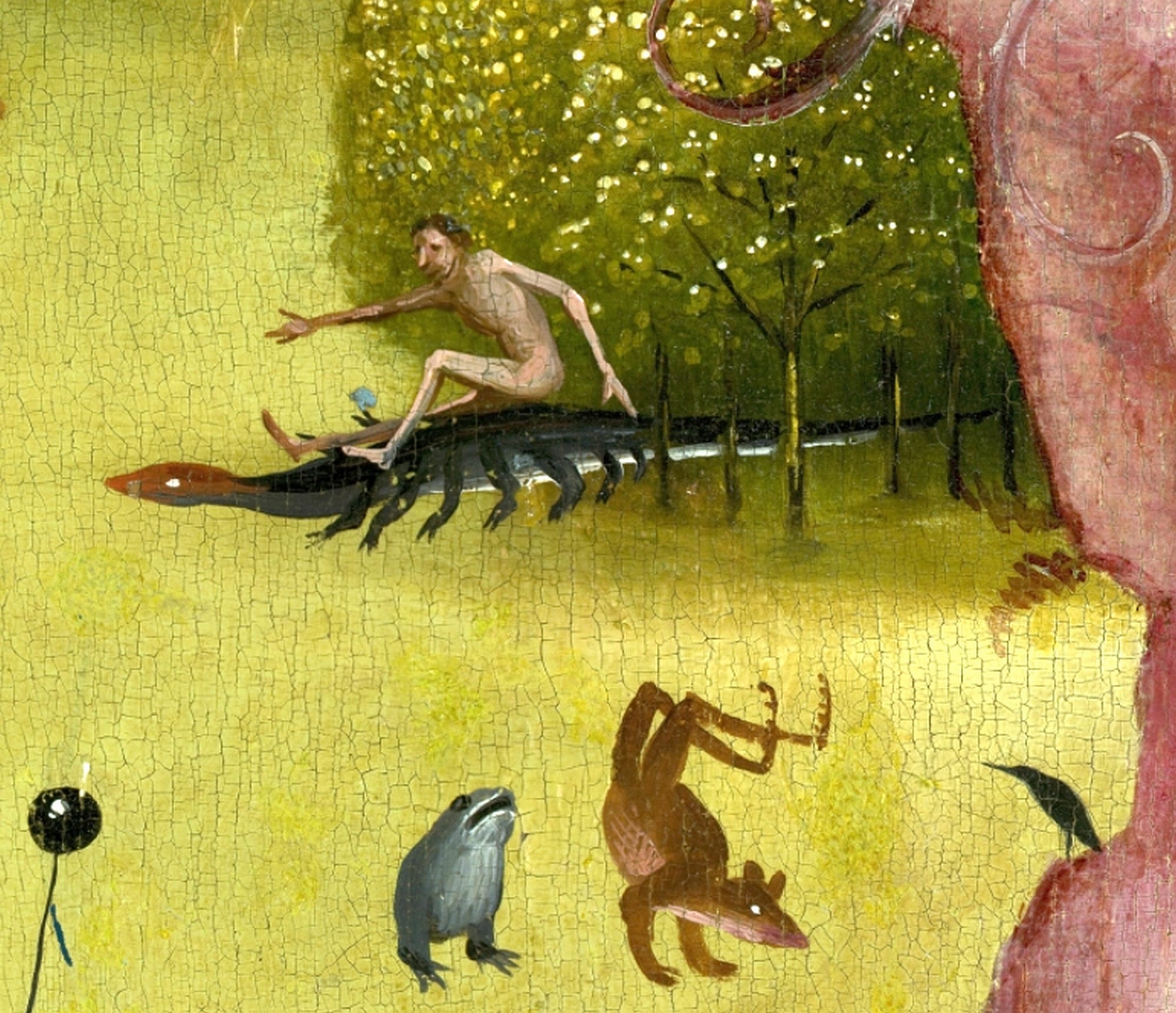
He is torn between the “Satan-Shadow” —(narcissistic mischief — weaponized mockery — sterility disguised as strength — digital dominion with no descendants)— versus the “Holy Fool” (the Sanctus Stultus) —(courageous truth-telling — comic disruption of evil — deep human connection made in wild and novel ways — childlike baptismal joy.) The bigger the archetype one embodies, the larger the shadow one must integrate: Christ descends into the Depths below the Depths — the deepmost place of all Unbecoming.The Trickster must too — into the Boschian Carnival of Hell— but he must not fall in love with the demonic, no matter how dazzling.
“[We must] fearlessly face within and engage the process of redemption and ownership of our darker angels.” — P.T. Mistlberger
“There is a sorcery to youth.” — Gustav Meyrink
Here the Christian Mystery gives the most precise warning: Lucifer was the brightest trickster —(dancing Davidlike before the enthroned Gottheit, afire with Divina Musica)— who refused the transformation into Love. So what does transformation look like? The anti-Luciferian — that is, bowing before God coming through Woman — deferring to an ungraspable Divine Infinitude that purposefully manifests Itself through the graspable Finite.
“I called her ‘Beatrice’ — though I never read Dante.” — Herman Hesse, Demian
It looks like chivalry — the Trickster kneeling before the Woman and vowing to defend her goodness against the counterfeit feminine: The Maria–Sophia nexus welcomed — the Lilith–Porneia vortex rejected — or — even more deeply — the Maria-Sophia protected from the Lilith-Porneia — the womb honored as sacred. Mythopoetically, the toad must choose whether the mud is his tomb — the capstone of death — or his chrysalis — the font of life.
“He will sit as a refiner and purifier of silver.” — Malachi 3:3
If the looming “Fuentean archetype” integrates his titanic shadow and embraces the protection of the authentically feminine, he would cease to be a “clown prince” and become the holy Imperator of the Knights Amphibian, leading the “lost boys” — the “ousted lepers” — out of the “sewer-masculinity” —(that is really anti-masculinity)— and into Christic fruitfulness — rewilding Manhood itself in his “generational run.” If he does not, the Trickster King becomes the Jester Tyrant, ruling over a swamp that drowns its children, paralyzed in putrid Dantesque bogs — hanged on the information superhighways of the Qliphoth.
“Every man is more than just himself — he also represents the unique, the very special, always significant and remarkable point at which the world’s phenomena intersect — only once in this way, and never again.” — Herman Hesse, Demian
“Mockery is the serpent coiled around joy; but thanksgiving uncoils it into song.” — Miriam of the Roses
The crossroads is real. Not only for him — but for every youth who laughs at his tricks — really, the Trickster figures and youth movements of every age. Because the Trickster is not a leader unless he learns whom to serve — the frog waits for a Queen.
Kneeling ≠ submission / Kneeling = direction
H.E.R.M.E.S. ☉ → C.R.U.X. ☩ H.E.R.M.E.S. = [H]ilaritas–[E]ris, [R]isus–[M]etis, [E]versio–[S]emina — “Joy/strife — laughter/cunning — subversion/seeds.” C.R.U.X. = [C]ompitum [R]egnans: [U]bi [X]enium — “The ruling crossroads: Where a gift is offered → “Ad compita, aut Typhon aut Stultus Sanctus.” HERMES (6) = Both solar brilliance (Phoenix) and the risk of self-inflation (Icharus); CRUX (4) = Satispassio and elemental ground. The Bright 6 must kneel to the squared 4 or it topples into shadow (🜄).
Athanor Domini: “Christian Rosenkreuz trägt einen Frosch in seinem Hut.”
4. The Baptism of Irony — From Meme-Mud to the “Many Mansions” of Temple Brick
“Tremble, since you must dwell for a trimester under the earth with the Dead in order to get rid of all imperfections.” — Irenaeus Agnostus
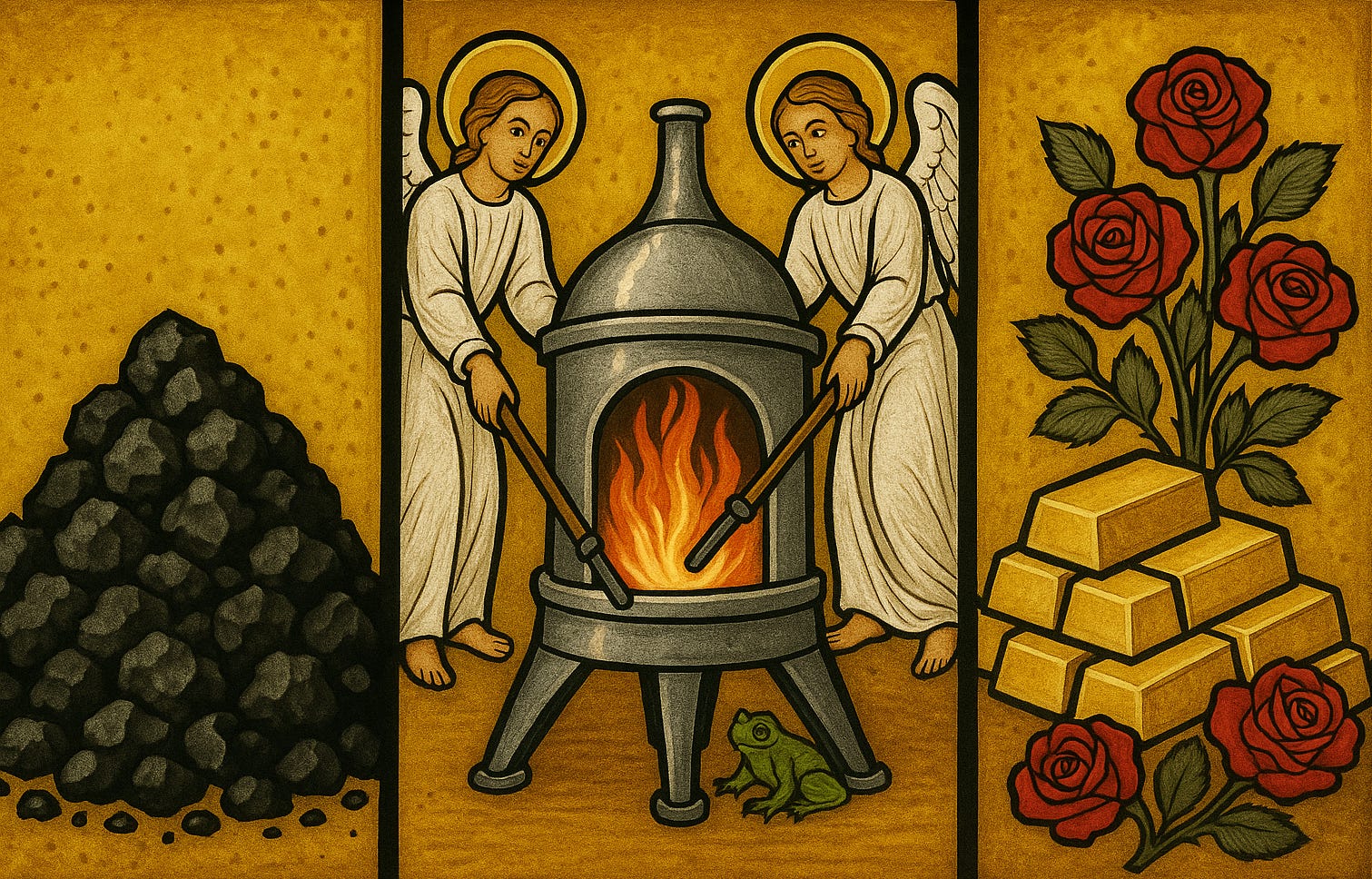
All men begin in the mud — the soil from which Adam rose and into which Christ descended (the Maria-Sophia foil.) Mud is potential: Soft enough to receive Form — rich enough to grow Life. But living mud left rotting and unattended breeds necrotic gnats and carrion flies — the Putredo Cadaveris. Irony is the mud of the digital soul: A cooling shield poured over wounds — a swamp where sincerity fears to emerge. Online youth — whether Groypers or any tribe — or, really, any youth — are caught between two destinies:
“I need only bend over the dark mirror to behold my own image, now completely resembling him, my brother, my master.” — Herman Hesse, Demian
Mud that becomes purposeful brickwork — hardened through fire —(and fibered with the Egyptian hay of the AnimaDivina)— shaped by mission — fitted into a Temple where others may dwell: Men becoming fathers, builders, protectors. Or mud that becomes swamp — paludes — stagnant, sterile — embryonic life drowned before rising: Youth dissolving into bitterness, resentment, entropy. (The “wasted youth crew” of Blood for Blood [see below])
“Now the kingdom of Heaven is not a far-off land, but a condition of the Heart. He who builds his temple in humility and serves the lowly is greater than all stately palaces; the mud of his feet becomes the foundation of a House of Gold.” — Jakob Lorber
The same substance — the Prima Materia. But two outcomes. The transformation happens in fire — self-lustratio — the alchemical crucible: The fire of responsibility — courtship and protecting the good — discipline, craft, community (beyond the internet — or, rather, the best of the internet efflorescing into IRL relations)— [5] the fire of faith that gives jokes a proper destiny. Irony baptized becomes joy. Mud sanctified becomes foundation — the Eckhartian Urgrund — Fundamentum Profundissimum.
A meme purified becomes the meaning of an entire world.
In the Great Christian Mythos, the Cornerstone is rejected before it is exalted. Christ Himself is called both “rock” and “stumbling stone” — and His Church — built on “Petrine rock” — is a Temple built of “living stones.” So imagine youth as amphibious bricks: Born in mud — tempered by alchemical waters — and finally fired into chivalric strength. The frog must choose the swamp —(enjoyable and esteeming as it, the “locker room” of natural camaraderie)— but that (eventually) suffocates its own offspring — or be a brick in the House of God.
“Não temas amar; pois o lodo ama o sol e, em seu amor, torna-se terra” (Fear not to love — for the mud loves the sun — and, in its love, becomes earth.) — Aurelius da Luz
And that choice cannot be encoded online. It must be lived. They — and we (I include myself more than anyone)— must — literally — touch grass. Internalize (and thereby salvifically externalize) deific Viriditas. Visit the Green Chapel. Seek the Sanctus Gradalis. Soak in the Steinerian Christ-Sun. Shed the Ahrimanic shackles. Consubstantiate the Anima Personalissima, the Anima Mundi and the Anima Christi into one holy embodiment.
Humor can only remain holy if it ultimately defends the innocent. The Knight Amphibian does not escape the mud — but redeems it.
“Who would be born must first destroy a world.” — Herman Hesse, Demian
“Light! More light!” — Wolfgang von Goethe (on his deathbed)
BLOOD FOR BLOOD’s immortal “Revenge on Society” — still one of my favorite albums. It is natural as a young man to want to be part of something that opposes something — and transgressively so. As a violence-prone hardcore kid in the 90s, my mantra was “I’m yelling ‘f— you’ till I spit my last breath!” I’d like to think I’ve matured since then.
5. The Eschatology of the Amphibian
“ …. That’s how it starts. The fever — the rage — the feeling of powerlessness that turns good men. .. cruel … ” — Alfred, Batman vs. Superman
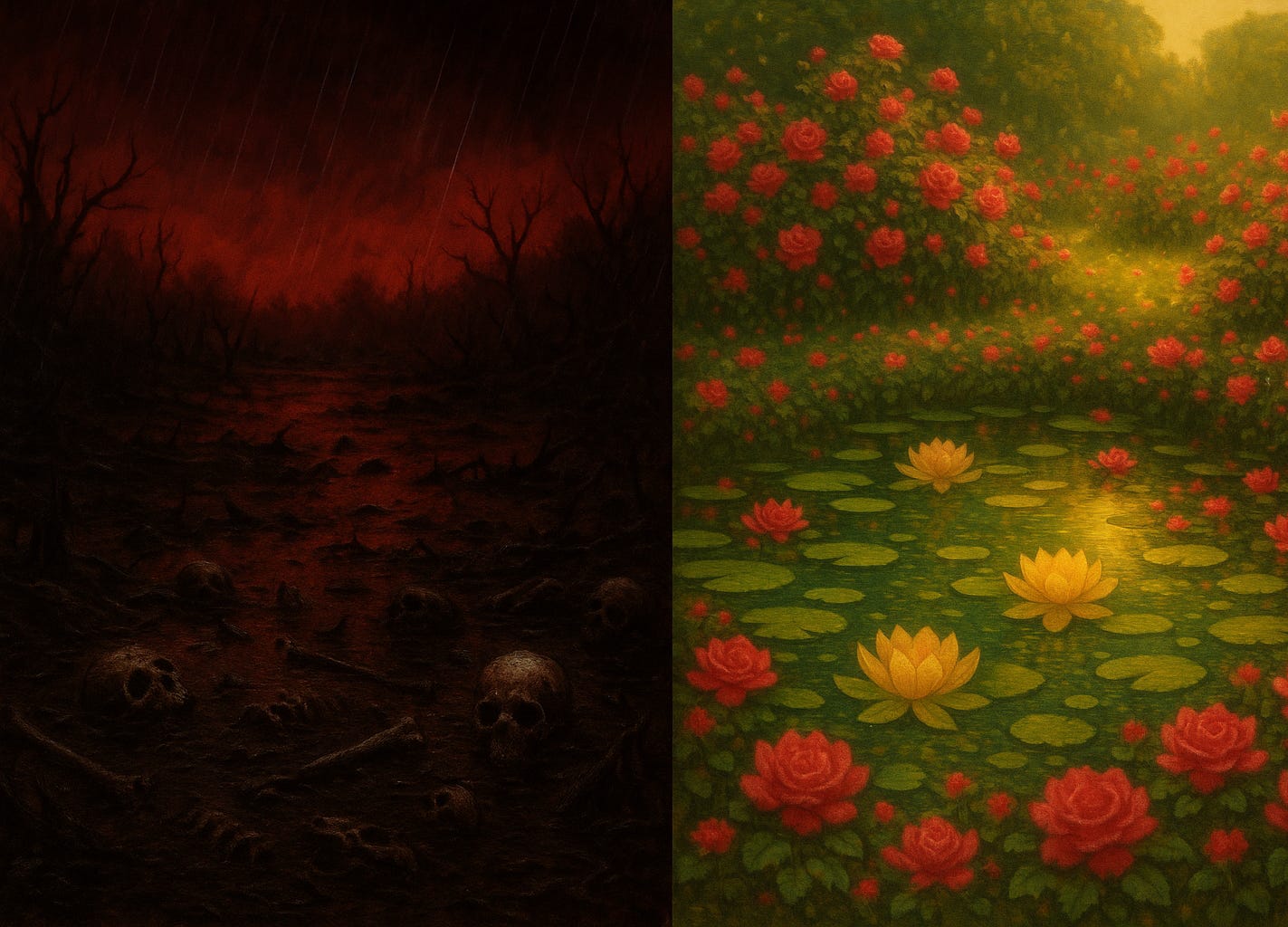
Every myth ends with a choice. Between Good and Evil — becoming Good or Evil — between Becoming and Refusing-to-Become. For the Trickster youth of our age — the “amphibian sons of the internet” — there are only two futures:
“I AM the Way, the Truth and the Life — I put before you Life and Death — choose Life that you might live — and live it in abundance.”
i. The Swamp Ezkaton — the Todessumpf
“ … Fillet of a fenny snake, in the cauldron boil and bake; eye of new and toe of frog, wool of bat and tongue of dog … ” — MacBeth, IV.i
“‘Think as I think,’ said a man, ‘or you are abominably wicked; you are a toad.’ And after I thought of it, I said, ‘I will, then, be a toad.’” — Stephen Crane
“I do not like men; they are vermin, and I am tired of their smell.” — Jonathan Swift
This is where Lilith–Porneia is enthroned in abortive filth and Sophia is exiled into profane matter. And what follows? Perpetual adolescence — sisterless brotherhood — barracks disguised as community — rage masquerading as strength — digital presence without real posterity. The Queenless Toad becomes his own tyrant, ruling over evaporating waters, watching ponds shrink into puddles — then thimblefuls … then nothing. A death-croak over eggs that never hatch is a horror I wish on no-one — neither the most misanthropic Groyper nor their most ardent opponent. A movement without wombs has no world to inherit. This is the hell of the Puer Aeternus — where the boy who refuses the bridge into Manhood because the bridge crosses through the Cross of the Divine Feminine —(the Crux Agonia)— where swamp-castles devour their own kings — where, to quote Tolkien, “The Mewlips feed.”
“Yesod —(Foundation)— must be raised into Tiferet —(Beauty)— else its waters stagnate and rot into the Qliphoth of Gamchicoth — the Devourers of Substance.”
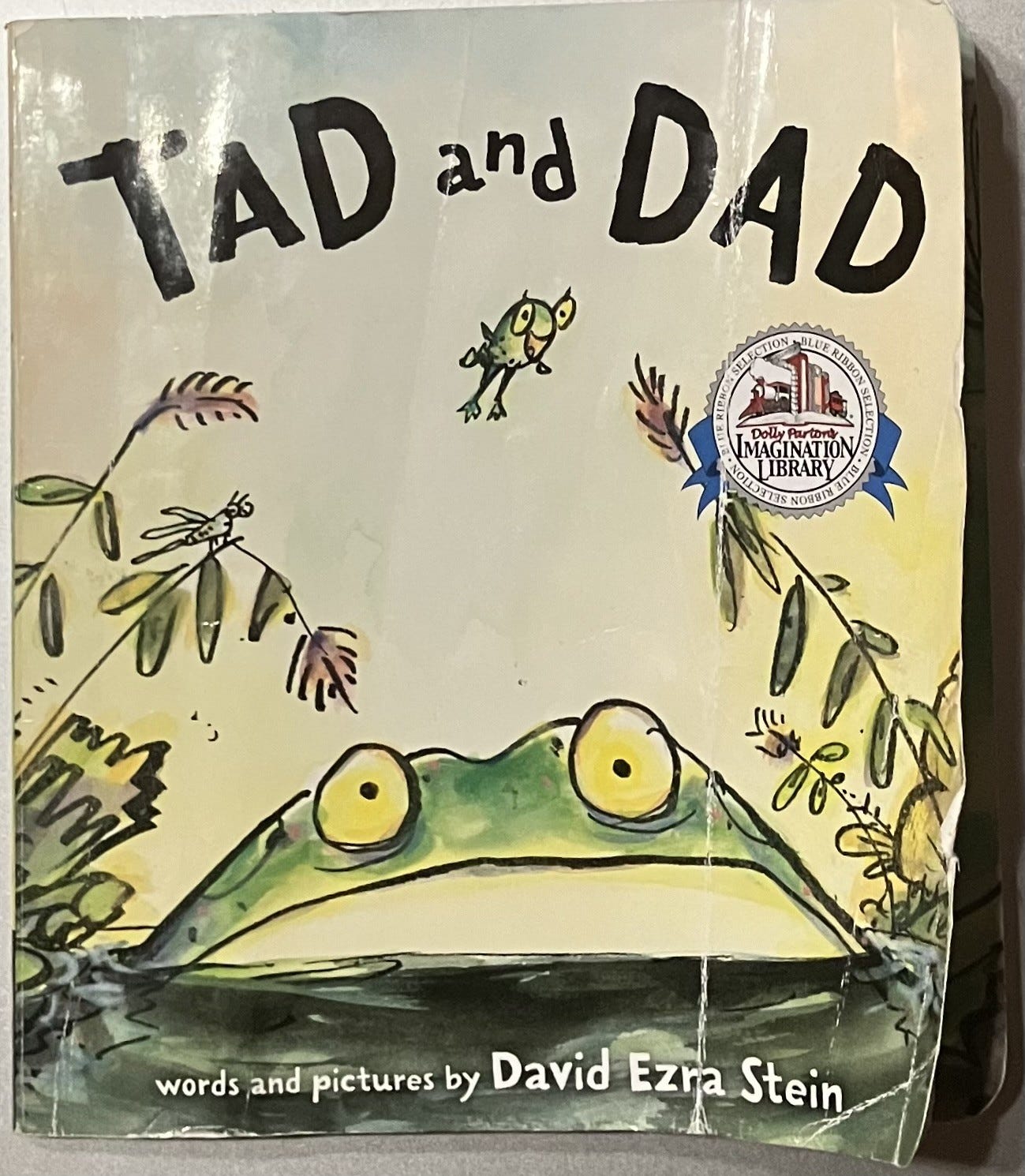
Presently my daughter’s favorite book. There is a deep trinitarian love between the Betrachian, the Innocent and the Anima.
ii. The Garden Ezkaton — Eden Restored
“We must build Light in the world — and build Light within ourselves — we must become Light — at all costs.” — Samael Aun Weor
“The duty of every man is the dignity of every woman.” — St. John Paul II
“The Kingdom of Heaven is a condition of the heart; every tear tainted with the blood of labor becomes mortar for the Temple of Light.” —Jacobus von Thalheim
Here, Maria–Sophia is enthroned as the Sun — the “Angel in the West Window” (Meyrink.) Lilith is disarmed. She flies into the Outer Darkness, death-sentenced by her own choices. Porneia is immolated into oblivion by the Vestal Virgins. What follows? Courtship instead of Conquest — Families instead of Factions — Protection instead of Derision — a homebound Fertility replacing a placeless sterile Irony — the building of hearts and hearths and halls. The Knight Amphibian kneels before goodness so that he may rise into greatness. He honors the Christic womb — the “crucible-forge” [6] — not as weakness — but as the ark of civilization — the Noahide Arca Civilitatis. He sees in woman the Gate of God — he sees God— the one through whom every warrior first entered the world. He wages war against anything that degrades her — including himself.
“The frog croaks all day in living joy — stirring in his puddle — praising the Lord with croaking joy — appreciating the great gift of his life.” — Jakob Lorber
Every brick of Zion was once mud defended by a guardian. To become a holy man, one must become a holy fool first: Willing to look ridiculous for love. To become a father, one must first protect the future mother. To become a saint, one must baptize one’s own memes. This is the “baptismal amphibiousness” awaiting the youth of our time. Their armor will be bronze — their humor will be gold. Their princess is Wisdom, and her mother is a Queen. Ultimately, the divinizing internal moral Titanomachies within every Groyper can birth gods.
[F]lamma [R]os [O]rans [G]lobum —> “Flamma ros orans globum — fiat incarnatio elementorum.” “Flame and dew, praying over the globe — let the incarnation of the elements be.” [M]ater [A]quae, [R]osa [I]gnis, [A]nima [M]undi —> “Mater aquae, rosa ignis, anima mundi — corona elementorum.” “Mother of water — rose of fire — soul of the world — the crown of the elements.” F.R.O.G. = four letters = the tetradic Foundation of Manifestation — Earth, Water, Air, and Fire) made flesh; M.A.R.I.A. = five letters = The Quintessence — Thus the Toad (4) crowned by Maria (5) yields 9, the gestational Number of infinite Divine Potential. (“Fiat mundus novem spirituum.” — Let the world of Nine Spirits be born.”)
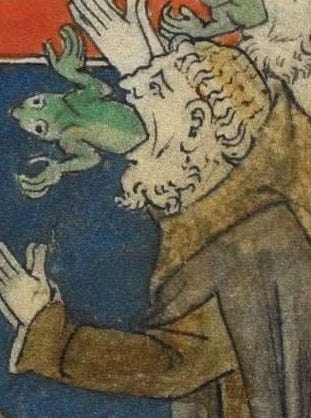
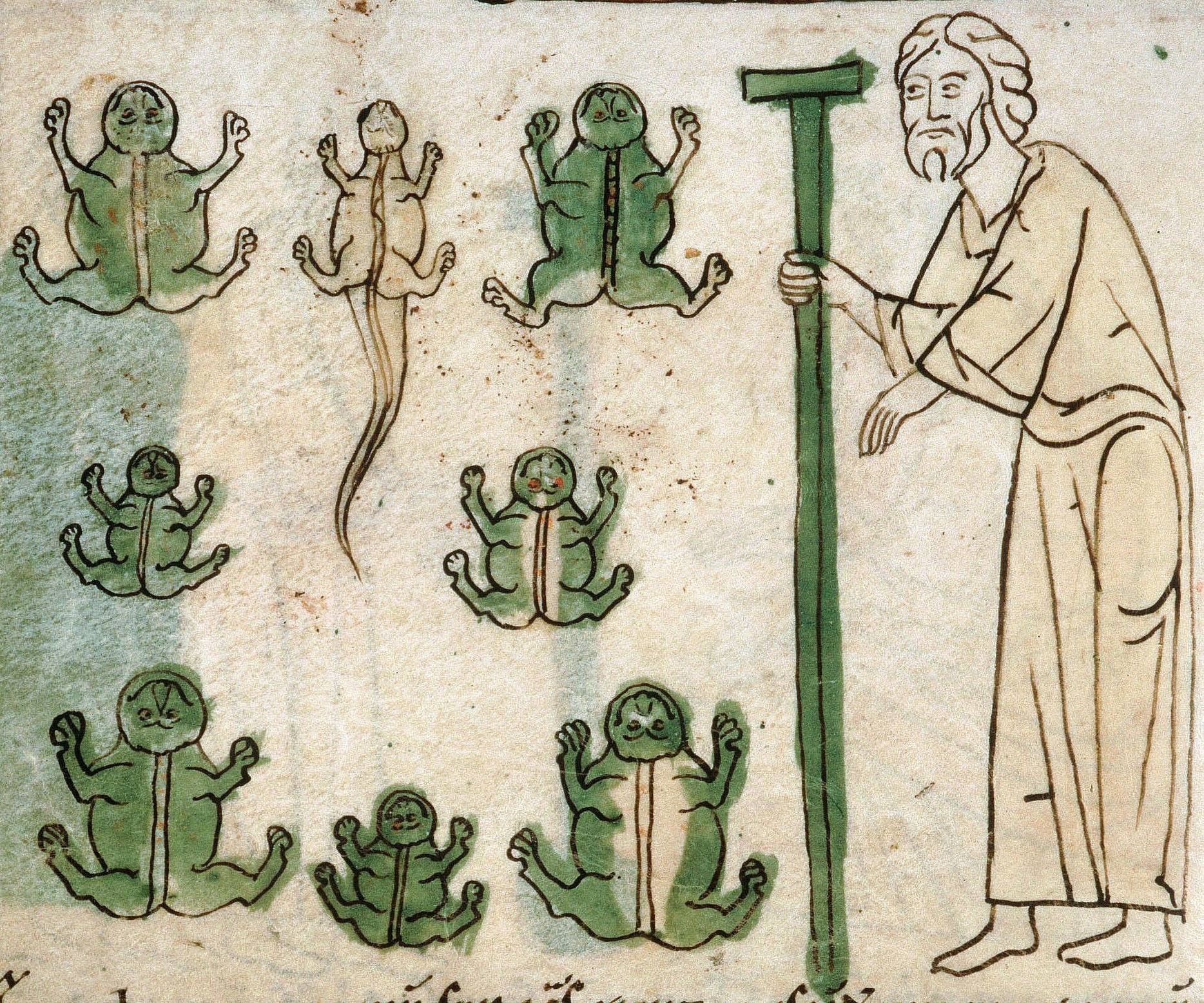
Green lies in both the curse of death and the wand of life that banishes the curse. “The Plagues of Egypt” from a medieval Psalter.
6. The Once & Future Groyper — The Alchemy of Choice
“The sun was black with judgment, and the moon blood — but, between, I saw man stand, saying: To me — at least — the grass is green.” — G.K. Chesterton, Femina Contra Mundum (Woman Against the World)
“Only through a dialogue between your conscious standpoint and that of the unconscious can you arrive at conclusions that do violence neither to outer reality nor to inner truth.” — Janet O. Dallet, Saturday’s Child: Encounters with the Dark Gods
“ … Many have said—though not always the mothers of the children themselves—that every newborn first resembles a frog: a small, uncertain creature, not yet wholly human, but shaping itself little by little into its destined form. And just as the child fashions its own likeness from formlessness, so too does the life within us unfold from its hidden seed — what once lay coiled in matter begins to stretch and breathe, and the soul unrolls the long scroll of its own becoming, revealing, page by page, the pictures of life we carried within us from the first … ” — Rudolf Steiner
In the Old World, a great croaking of frogs would precede heavy rains: Frogs would be ritually impaled by cunning-men and their death-utterances used to prognosticate whether the downpours would endow life or destroy it. Is that what we are doing to young men today — killing them to tell the future?
The individuation of the Groyper is really the tale of the Everyman — the “pre-Christ” — the archetypal Homo Viator. There is a kind of “multipolar onus” on all members of this moral (and immortal) drama, and there are ever-proliferating possibilities. The Mother-Who-Kills can smother the Groyper-Son. The Mother can be killed (or kill herself), overrun by the Groyperkinder. A forgiving society can integrate the Groyer-shadow and arrive at a fuller fire — an Ignis Plenior. The Fuentean archetype [7] can embrace the Christ-self. As posited, a culture becomes sterile when its men mock the womb instead of defending it — but it must have wombs to defend and wombs willing to be defended.
Men must be allowed to let their wild angels dance and shout glad tidings through the dark cacophonies of their most terrible demons.
All can be fragmented in deathly flame — dis-alchemized — satanized in the Dark; all can be reconstituted in living fire — forgiven into gold — deified in the Light. An Esoteric Groyperism is an anti-egregore, an endeavor of alchemical will — Marian and Sophianic — innervated with Weorian Christification — an Orphic, organic groundswell of “Storm” and “Stress” redeemed into Living Rain and the Tempering-of-Blades — innervating the Cosmos, eucharizing the Toadstone. A purified soil — pruned of self-sabotaging sin and souring concupiscence — can be the seedbed of innumerable Roses — indeed, the Rosa Summa.
“Imagination and will are the two poles of the mind. The Imagination is feminine — the Will is masculine. The key to success is when the Imagination and the Will unite in vibrant harmony.” — Samael Aun Weor
Plague-bearers or frog-princes? Whether one militantly loves or homicidally abominates the Groyper movement, this much is true: Dialectically, there was a — “pre-Groyper world” — a thesis — and now a “world of Groypers” — an antithesis — what this analysis hints at is not a synthesis … but the possibility that there might be something like a synthesis. Time will tell.
CHIRISTOS is a purposeful misspelling of CHRISTOS in some alchemical texts to include IRIS — Rain, the Refraction of Colors, Psychopomp, Flower and the Human Eye — within ‘Christ.’ A.M.P.H.I.B.I.A. → C.H.I.R.I.S.T.O.S. AMPHIBIA = [A]qua–[M]are, [P]neuma–[H]alitus; [I]n [U]tero, [B]-[I]n-[A]ere — “Water/Sea — Spirit/Breath — in the Womb, then twice in Air.” CHIRISTOS = [CH]aris, [I]esus, [R]osa, [I]gnis, [S]apientia, [T]emplum, [O]rigo, [S]ponsus — “Grace — Jesus — Rose — Fire — Wisdom — Temple, Origin — Bridegroom.”“Amphi-bios in Christo: De LIMON ad LUMEN.” — “Double-life in Christ: from Slime to light.” AMPHIBIA (8) = The Octave of New Creation; CHIRISTOS (8) seals it — two octaves consonant: Nature (🜃) raised into Grace (🜍).
The Chthonic Creature kenotically descends into the Subchthonic depths to wrestle with the Dark Self; having successfully integrated his Shadow, he ascends, first, from the subterrestrial realm into the Material — then theotically into the superterrestrial where he earns both Mantle and Mission — a Mission that will call him back down again, belliferously, into the terrestrial and Material.
Appendix — Let’s Get Extra-Esoteric:
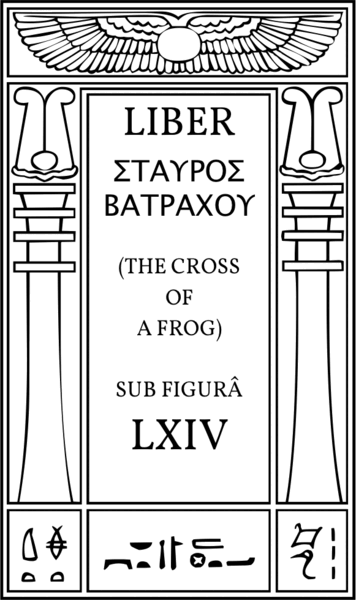
1.) The Groyper vs. the Great Beast: Stauros Batrachou — Crowley’s “Frog on the Cross” & the Crucifixion of Sincerity
In Liber LXX, Crowley consecrates a living frog as “Jesus of Nazareth.” He keeps it overnight “in an ark or chest,” sprinkles it with water “in the Name of the Father ☩ and of the Son ☩ and of the Holy Ghost,” worships it through the day, promises it miracles, and secretly carves a cross. At night he arrests it, recites a mock indictment for “blasphemy and sedition,” pronounces sentence as To Mega Therion, crucifies it, stabs it “to the heart with the Dagger of Art,” eats its legs “as a sacrament,” and burns the rest “to consume finally the aeon of the accursed one.” The rite parodies Baptism, Eucharist, Passion, and Resurrection, collapsing them into an act of theophagy and desecration.
Crowley’s frog is a scapegoat-Christ designed to invert Grace: He enthrones Will by consuming — and so “ending”— the Christian symbol he has mocked into a mud-creature. It is an anti-Mass whose “sacrament” is not Eucharistia but domination: The will to ingest a sign until it cannot accuse. As ritual technology, it doesn’t merely blaspheme; it weaponizes parody to cancel Tradition’s generative center — womb, altar, table — and replace it with a solitary, performative appetite. Within Crowley’s mythos, it dramatizes the execution of the “Slave-God” to inaugurate a new epoch. [8]
But the Groyper carries a double valence — plague-omen and proto-martyr, drownable uterine mud and baptismal emergence, Lilith-Porneia and Maria-Sophia. Crowley chooses one horn — the plague — and performs a ritual of irony that nails sincerity to wood. Igneous Jugendkultur — especially modern Memekultur — often unconsciously reenacts this: Crucifying sincerity on the cross of the joke so that nothing obligates us to love. That is the Crowleyan impulse hiding inside certain strains of online toxicity: If the frog becomes Christ, kill the Christ so the insult can live.
Crowley’s Rite of Fixation ends in consumption (“eat!”— “burn!” — “finish it!”) Its aim is at sterility-as-victory: No Bride, no Temple, only the isolated sorcerer’s false apotheosis — a suicidal maggot in the murdered corpse of the Lilith-Porenia — a terminal Nigredo with no Albedo beyond the celebrant’s ego-elevation. Conversely, unindividuated Groyperhood is raw potential, unfated to desecration, capable of alchemizing meme-mud into Temple brick on the Marian-Sophianic track of chivalry, courtship, fatherhood, and altar. The Groyper has access to a baptismal amphibiousness that Crowley deliberately refuses. Crowley’s logic: “If the symbol accuses me, devour it.” Folk Mariology’s logic (§2): “If the symbol wounds me, mother it.” One path crushes the frog to cancel Christ; the other crushes the ego and crowns the frog by placing it at the Virgin’s feet so Christ may be born again in the mud of hearts and minds, through Spiritus Sanctus, Sacramenta, Vita Ecclesiae, et Sapientia. Crowley’s fire is the cremation of meaning; this fire is the engoldening kiln freeing the holy toadstone from the dross of meaninglessness.
Where Crowley ends with “burn the rest,” we must end with “build the rest.” Leave the screen, find a chapel, guard a woman, plant a garden, baptize the joke. If a movement unconsciously performs Crowley’s anti-Mass every day —(killing the tender thing before it obligates)— we must be the mages who offer the counter-rite: Kneel → protect → wed → beget → build. “Let the frog live long enough to sing psalms.” Love is the Divina Magica where the Frog becomes Christ Himself and inaugurates a New Aeon.
Numerologically, assigning A = 1, B = 2 … Z = 26: G (7) + R (18) + O (15) + Y (25) + P (16) + E (5) + R (18) = 104. 1 0 4 → 1 + 0 + 4 = 5 → i.e., the Quintessence / the Fifth Element — bridging Four Elements with Spirit. 104 in Hebrew gematria roughly corresponds to נגד (Neged), “opposite” or “facing.” The Trickster stance: Opposition as mirror. Alternatively, in reduction through Pythagorean digital root (the sum of letter values mod 9): ( 7 + 9 + 6 + 7 + 7 + 5 + 9) = 50 → 5 + 0 = 5 again. The Individuated GROYPER archetype’s destiny is Quintessential: Mediating — synthesizing — uniting. Astrologically, GROYPER is composed of seven letters corresponding to the seven classical planets. Let us assign each sequentially: G (Sun) → Radiance and the Ego-Seed of self-awareness; R (Moon) → Reflective instinct and mimicry; O (Mercury) → Speech and message; Y (Venus) → The desirous yearning for Beauty and Conjunction; P (Mars) → Willfulness, militancy and the defiance of Jugendflamme; E (Jupiter) → Expansion, jovial overgrowth and humor; R (Saturn) → Irony, restraint, mortality, and the finality of moral boundedness. GROYPER spans the entire Septenary, a planetary chain — the whole visible Cosmos in one fiery Froschquaken. The seven letters of GROYPER can be rendered into seven tones of the diatonic scale: G-R-O-Y-P-E-R → G – A – B♭ – C – D – E – F (approximately phonetically), tracking the Phrygian mode — plaintive, ironic, penitential. Hence in the Sacred Mu, GROPYER is the Canticum Paenitentiae — the “Song of Repentance” — sung in jest. Numerically (104 Hz fundamental ≈ G₂) gives a resonant overtone of 208 Hz, “Human Voice” register — the Meme longs for incarnation into Song. Gematriacally, GROYPER is approximately transliterated: ג(3) + ר(200) + ו(6) + י(10) + פ(80) + ר(200) = 499 → which reduces to 4 + 9 + 9 = 22 → The full number of Hebraic letters → Total linguistic potential — the Logos as Alef-Bet. Cabalistically: “He who croaks contains all tongues.” 499 corresponds to Hebrew תֹּרֶף (toref) — “prey, spoil” — implying the Devourer of Meaning (Gamchicoth) is transmogrified into Sacrificial Meal (Eucharistia). Isopsephically, GROYPER — transliterated ΓΡΟΫΠΕΡ — expands Γ (3) + Ρ (100) + Ο (70) + Ϋ (400) + Π (80) + Ε (5) + Ρ (100) = 758. → 7 + 5 + 8 = 20 → 2 = Duality — again, the Amphibian Number. 758 links to the word σοφία (Wisdom) = 781 ≈ same octave: Groyper Individuation moves In the Shadow of Sophia. Finally, temurahically —(i.e., in letter permutation alchemy)— using the Atbash cipher (A↔Z, B↔Y, ...): GROYPER approximately yields TIPBKV. In numeric sum = 20 → Resurrection. The inversion yields “tiph-bkv”, echoing Hebrew טוב (tov) = “good.” Bonitas in deformitate latet:There is hidden goodness in grotesquery.
Notes:
* Dorothy Sayers wrote that endeavoring for Truth can only be achieved when balancing on a “small, sharp, single hair strung tight across” the abyss — while paradoxically inebriated with the Blood of Christ.
[2] Schipflinger discusses Sophia/Shekinah as the “Bath-Kol” — the Daughter of the Voice — that “pervades everything” and gives structure to structure itself — the incarnated Malkhut-Thresholdthat “receives all emanations.”
[3] I use the term “Basicath” —(a Catholic who does not appreciate their Faith’s rich mystical patrimony)— yet again, to (hopefully) anger that one Substacker (and his ilk) who shat on my work. I still think you suck.
[4] I believe it was Edinger who called the “Primordial Toad” the Nigredo Homunculus whose “venom” was a kind of “untransmuted libido” that could — if left unchecked — destroy the world. Contact me for correction or corroboration.
[5] Not knocking the interweb, homie.Online we weave connections — true ones — but in meeting, we transubstantiate them — for the Logos is always longing to be made flesh. Digital communion is promise — embodied presence is resurrection.
[6] Again, the Fulcanellian green language: Every frog needs a forge to fructify — every toad must be tried and true in the Tod-des-Ichs. The amphibious becomes amorous and ambrosial in its Grail-Quest.
[7] Not only the archetype of Nick Fuentes, but Miguel de Unamuno’s San Manuel Bueno, Mártir, the Quixotic Man, Tirso de Molina, Molière, Mozart and Lope de Vega’s Fuente Ovejuna.
[8] Crowley’s 666 signifies the tripled sun, Tiferet enthroned upon itself — the self-deifying blaze of the Beast, light estranged from grace (solar overreach — the Christless desert.) By contrast, 777 is the Ladder of Return, the triadic harmony of Netzach, Hod, and Yesod — the ascent of devotion, intellect, and foundation into restored order. Between them leaps the frog, the amphibian of alchemy, amphi-bios, “doubled life” — life in abundance — who rises from water to ether as the soul from unconsciousness to actualization. The frog’s metamorphosis baptizes the Beast: The egoic sun drowns in the abyss of the womb (Abyssus Matricis) and emerges as the Logos Amphibius — the reconciled light. Thus the frog embodies the numerological transmutation 666 → 777, Baptismus Ranalis: The Beast redeemed in Viriditas Vida, the Sol reborn through mud into Spiritus Magnus.
“Theories pass. The frog remains.” — Jean Rostand
Karin, the Knight’s Wife: “Now I can see that it’s you. Somewhere in your eyes, somewhere in your face, but hidden and frightened, is that boy who went away from me so many years ago.”
The Knight (having returned from the Crusades and journeyed through the Plague): “It’s over now and I’m a little tired.”